Same Couch, Different World: How Split-Screen Gaming Became the Hangout We Didn't Know We Needed
Let's be honest: actually hanging out with your friends has gotten kind of complicated. Between work schedules, kids, commutes, and the general chaos of adult life in America, the idea of getting everyone in the same room feels like it requires a project manager and a shared Google Calendar. So when it does happen — when people actually show up, sit down, and spend a few hours together — you want it to mean something.
That's where split-screen gaming is quietly stepping up and filling a gap nobody really planned for.
The Screen That Brings People Together (By Dividing Itself)
For a while, it felt like local multiplayer was on its way out. Online play exploded, developers chased bigger budgets and smoother solo experiences, and the humble split-screen mode got quietly dropped from franchise after franchise. Why build for two people on the same couch when you could build for millions of people on different continents?
But something funny happened after the pandemic reshuffled how we think about in-person time. People started craving presence again — not just a Discord call, not a party chat, but actual physical proximity. And for a whole lot of friend groups, that rediscovery happened with a controller in hand and a TV screen cut neatly in half.
"There's something about seeing your friend's actual face react to the game that you just can't replicate online," says Marcus, a 31-year-old from Columbus, Ohio, who hosts a monthly gaming night with three college friends who've all scattered across the Midwest. "We play online all the time, but it's different. When we're all in the same room, it's louder, it's dumber, it's funnier. It's just more."
That "more" isn't just vibes. There's actual psychology behind why side-by-side play feels distinct from its online counterpart.
Why Playing Next to Someone Just Hits Different
Researchers who study social bonding have long pointed to something called "synchrony" — the phenomenon where shared physical experiences create stronger feelings of connection between people. It's why concerts feel electric, why watching a game at a bar beats watching it alone at home, and why two people laughing at the same thing in the same room is a fundamentally different experience than sending each other memes.
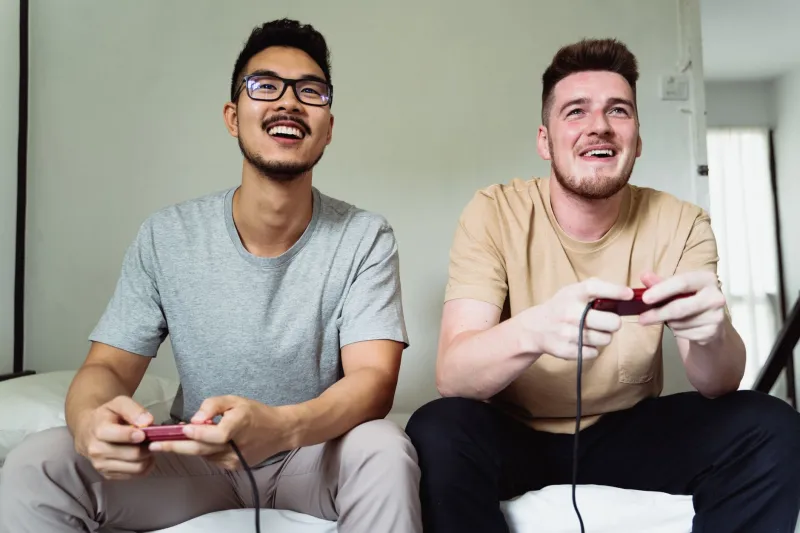
Local multiplayer taps directly into that. When you're sitting next to someone, you're sharing physical space, reacting in real time, bumping shoulders, trash-talking at full volume. The feedback loop is immediate and embodied in a way that online play, for all its conveniences, simply isn't built to replicate.
There's also an accessibility factor that doesn't get talked about enough. Not everyone in a friend group is a dedicated gamer. But hand someone a controller, sit them next to a person they already trust, and suddenly the barrier to entry drops dramatically. The social scaffolding is already there. The game just becomes the activity you're doing together — like bowling, but in your living room.
The Games Making It Worth It Right Now
The good news is that developers have clearly gotten the memo. After years of local co-op feeling like an afterthought, there's a genuinely strong lineup of split-screen and couch co-op titles worth gathering around.
It Takes Two remains the gold standard for cooperative storytelling. Designed from the ground up as a two-player experience, it's the kind of game that non-gamers can pick up without feeling lost, while still offering enough mechanical variety to keep things interesting for veterans. It also has a free "Friend's Pass" feature, which means only one person in the room needs to own a copy.
Overcooked! All You Can Eat is organized chaos in the best possible way. It's a cooking simulation that will absolutely destroy friendships in the funniest way imaginable — perfect for a group that can take a joke.
Halo: The Master Chief Collection holds up as one of the best local co-op shooters you can still find, and it's on Game Pass, which lowers the cost of entry considerably. For friend groups with any kind of gaming history together, running through old Halo campaigns side-by-side carries a specific kind of nostalgia that lands hard.
Teenage Mutant Ninja Turtles: Shredder's Revenge scratched an itch for side-scrolling brawler fans everywhere and supports up to four players locally. It's loud, colorful, and requires approximately zero explanation to someone who's never touched a controller.
Minecraft and Stardew Valley round out the list for friend groups who'd rather build something together than compete. Both support local co-op and have a meditative quality that makes them great for longer hangs where conversation is just as much the point as the gameplay itself.
The Logistics Are Actually Getting Easier
One thing that used to kill local multiplayer nights before they started: not having enough controllers. That's still a real consideration, but the market for third-party controllers has improved significantly, and services like Xbox Game Pass and PlayStation Plus have made it cheaper than ever to have a solid library of co-op titles ready to go without spending a fortune.
The bigger shift might be in living room setups. Larger TVs at lower price points mean split-screen doesn't feel as claustrophobic as it did on a 32-inch set in a college dorm room. Two people looking at two halves of a 65-inch screen is a genuinely comfortable experience — not the squinting exercise it used to be.
"We've got a setup now where the TV is big enough that nobody complains about the split," says Janelle, a 28-year-old from Atlanta who plays with her sister every time they visit. "It used to be the excuse to not bother. Now it's just not an issue."
A Different Kind of Quality Time
Here's the thing nobody really talks about when they make the case for gaming as a social activity: it takes the pressure off. Hanging out with people you don't see often can carry this weird weight — the sense that you should be having deep conversations and making the most of every minute. Gaming dissolves that pressure almost immediately. You have a shared task, a shared screen, a shared set of stakes. The conversation happens naturally because you're not trying to force it.
That's not a replacement for real connection. It's a vehicle for it.
Split-screen gaming isn't going to solve the logistical nightmare of adult friendship. It's not going to make schedules align or shorten the drive between cities. But when the stars do align and everyone ends up in the same room? Having a controller to hand someone is one of the easiest ways to turn a regular visit into something people actually remember.
Same couch. Divided screen. Undivided attention. That's the whole deal — and right now, it's one of the better hangs going.