No One Left on the Bench: How Games Are Finally Letting Every Player Into the Game
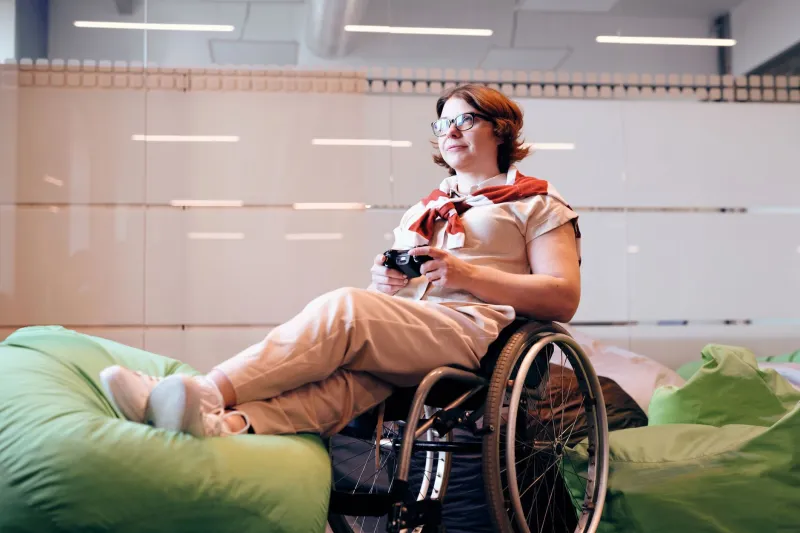
There's a moment Marcus recalls vividly. He'd been a gamer his whole life — grew up with an SNES, burned through high school on Halo, logged hundreds of hours in RPGs through his twenties. Then, in his early thirties, a degenerative condition began affecting the motor function in his right hand. Buttons he'd pressed without thinking became unreliable. Combos felt impossible. He quietly shelved his controller and told himself that chapter of his life was probably over.
Then a friend sent him a link to a settings menu screenshot from The Last of Us Part II. It had 60-plus accessibility options.
"I literally sat there reading it like it was a menu at a restaurant I thought was closed," he says. "Like — wait, I can actually order something here?"
Marcus isn't alone. Across the country, players who'd written off gaming due to visual impairments, hearing loss, motor disabilities, cognitive differences, or chronic pain are finding their way back — or in some cases, finding their way in for the very first time. And it's not happening by accident.
The Industry Woke Up — Slowly, Then All at Once
For most of gaming history, accessibility was an afterthought at best. A subtitle toggle here, a colorblind mode there, usually buried three menus deep and half-broken at launch. Disabled players either adapted through sheer determination or got left out entirely.
The shift started picking up real momentum around 2018 and 2019, when titles like God of War and Celeste began treating accessibility as a design priority rather than a checkbox. Celeste in particular made waves with its "Assist Mode" — a suite of options letting players slow the game's speed, add extra dashes, or turn on invincibility. Creator Maddy Thorson was explicit: the mode wasn't cheating. It was an invitation.
That framing mattered. It reframed accessibility not as dumbing things down but as widening the door.
From there, the momentum built. The Last of Us Part II arrived in 2020 with what many accessibility advocates called the most comprehensive options package ever shipped in a major release. High-contrast modes, full controller remapping, one-handed presets, text-to-speech for menus, traversal assistance — the list was staggering. Naughty Dog had worked directly with disability consultants and community members throughout development. The result wasn't just functional. It was thoughtful.
What "Accessible" Actually Looks Like in Practice
It helps to break down what modern accessibility features actually cover, because the term can feel abstract until you see it in action.
Visual accessibility includes colorblind modes (often multiple types, since colorblindness isn't one-size-fits-all), high-contrast UI options, adjustable text size, screen readers for menus, and options to reduce visual clutter like flashing lights or particle effects that can trigger photosensitive epilepsy.
Motor accessibility covers full button remapping, one-handed controller configurations, toggle options for actions that would otherwise require holding buttons, reduced quick-time event demands, and compatibility with adaptive controllers like Microsoft's Xbox Adaptive Controller, which lets players build custom setups using switches, foot pedals, and other external inputs.
Hearing accessibility goes beyond just subtitles. Modern implementations include visual cues for directional audio (so deaf players can tell which direction a sound came from), closed captions that distinguish between dialogue and environmental sounds, and speaker labels so players know who's talking in cutscenes.
Cognitive and difficulty accessibility includes options like extended tutorial time, the ability to pause during combat, simplified control schemes, and — increasingly — robust difficulty customization that lets players tune specific systems independently rather than choosing between a hard mode and an easy mode that changes everything at once.
Games like Hades, Returnal, and Elden Ring have all approached difficulty in notably different ways, sparking ongoing community debate about where accessibility ends and intended design begins. It's a real conversation, and it doesn't have easy answers. But the fact that it's happening loudly, in mainstream gaming spaces, is itself a sign of progress.
The Advocates Pushing the Industry Forward
Organizations like AbleGamers, SpecialEffect, and Stack-Up have been doing on-the-ground work for years — providing adaptive equipment to players, consulting with studios, and advocating loudly when games ship with poor accessibility options. Their influence on how developers think about these features has been significant.
Steve Spohn, a longtime figure at AbleGamers who passed away in 2023, was one of the most prominent voices in this space. His work helped shift the industry's understanding of what was at stake. For many disabled players, gaming isn't just entertainment — it's a primary means of socializing, competing, and maintaining a sense of agency and connection when physical limitations restrict other activities. That's not a niche concern. That's millions of Americans.
The CDC estimates roughly 61 million adults in the US live with some form of disability. Even a fraction of that number represents an enormous audience that gaming has historically underserved.
The Gaps That Still Exist
For all the progress, the industry hasn't solved this. Not even close.
Accessibility features are still inconsistently implemented. A game might have excellent visual options but no motor accommodations. Multiplayer titles often lag behind their single-player counterparts — it's easier to design accessible systems into a linear narrative than into a competitive online environment where balance concerns get tangled up with accommodation. Indie developers, who often lack the resources of major studios, face real constraints even when the intention is there.
There's also the documentation problem. Players often don't know what accessibility features a game has before they buy it. Unlike film ratings or content warnings, there's no standardized system for communicating this upfront. Some platforms and databases have started filling that gap — Can I Play That? is a dedicated accessibility review site that's become an invaluable resource — but a unified industry standard would go much further.
And then there's the cultural piece. Despite all the progress, disabled gamers still report encountering dismissiveness in online spaces, assumptions that accessible options somehow diminish the "real" experience, or skepticism about whether they're "real" gamers. That's a community problem as much as a design problem.
What Comes Next
The trajectory is genuinely encouraging. Major publishers are increasingly hiring dedicated accessibility leads. Sony, Microsoft, and Nintendo have all made public commitments to accessibility in hardware and software — with Microsoft's work around the Adaptive Controller standing out as an industry benchmark. More developers are conducting playtesting with disabled users during development rather than retrofitting features post-launch.
AI-assisted tools are also opening new possibilities: automatic subtitle generation, adaptive difficulty systems that respond to player performance in real time, and interface personalization that learns individual needs over time.
For Marcus, the journey back into gaming has been gradual but real. He plays mostly on PC now, with a custom button layout and a few assistive peripherals. He finished Hades. He's deep into Baldur's Gate 3. He streams occasionally on Twitch, where he talks openly about his setup and gets messages from other players figuring out their own configurations.
"The games got better," he says. "But honestly, what changed most is knowing there are people who thought about me when they built the thing. That sounds small. It doesn't feel small."
It doesn't. And if you're a gamer who's never had to think about accessibility features, that's exactly the point — someone built those options so you wouldn't have to, and someone else gets to play because of it. That's what a bigger, better gaming community actually looks like.